Eric Mackay
It Shouldn’t Take a Breakdown
What happens when culture that has normalised 'collapse' as entertainment and how to we come back from this to genuinely care again?
Back in 2007, I went to see Amy Winehouse at Brixton Academy. I didn’t stay until the end; I couldn’t. I walked out partway through, and not because of Amy (well, partly because of Amy), but fundamentally because of the crowd. These weren’t fans; these were prospective mourners. Every time she stumbled off stage and returned a little more unsteady and a lot more high, the atmosphere thickened with anticipation. It wasn’t excitement for the next song - it was the grotesque tension of people waiting for a tragedy to unfold in front of them.
It was, and remains, the most uncomfortable gig I’ve ever been to. What was billed as a concert felt more like a wake in progress. And standing there, I realised that by staying, I was part of it - complicit in the theatre of someone else’s unravelling. The music barely mattered. The performance people wanted wasn’t Amy singing; it was Amy collapsing.
So I left. Not angry at her, but angry at us. At the industry that pushed her to that point. At the press who feasted on every stumble. At the audience who seemed to have come less for a show than for a spectacle. I didn’t like it then, and I don’t like it now.
That night has stayed with me. It shaped the way I look at artists and at audiences, but also at the wider culture we’ve built - one that doesn’t just tolerate collapse, but waits for it, expects it, even demands it. Which is why, when I saw Lil Nas X’s name flash across the headlines earlier this month, I already knew what the story would be.
The Arrest That Went Viral
Lil Nas X - Montero Lamar Hill - was arrested in Los Angeles in August. The headlines were everywhere within hours: wandering barefoot in cowboy boots and underwear, hospitalised, then jailed on multiple charges. By the time I saw the news, the footage had already been sold to TMZ, the memes had begun circulating, and someone had even attempted to sell his discarded boots online.
I made a deliberate decision not to watch the videos. I knew that if I did, I’d become part of the problem. Because let’s be honest: the act of watching isn’t neutral. Every click is a data point. Every replay is a signal. Watching says, “Yes, more of this, please.” And the economy of collapse - from tabloids to timelines - is all too happy to oblige.
The fact that I didn’t need to watch to know what was in them tells you everything. We’ve all seen this story before, with different names and faces. The choreography is predictable now: a stumble, a camera, a viral moment, the public consuming it in real time. The only thing that changes is the costume.
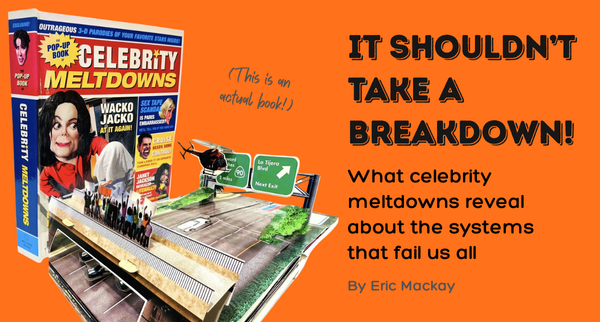
His father called it “the ultimate price of fame.” And he’s right, but I’d argue it’s bigger than that. It’s not just the price of fame - it’s the price of a culture that has normalised collapse as entertainment. We don’t simply document these moments; we monetise them. The breakdown itself becomes the product, packaged, circulated, sold.
What unsettled me wasn’t just the arrest, or even the fact that he was unwell. It was the speed with which the entire episode was converted into content. Within hours, his lowest moment was stripped for parts - a headline, a meme, even his boots on auction. And all of it consumed with the casual inevitability of, of course.
That phrase - of course - is the real indictment. Of course TMZ bought the footage. Of course the internet made jokes. We don’t even pretend to be shocked anymore. We expect it. And in expecting it, we invite it.
A Familiar Pattern We Pretend Not to See
Amy Winehouse, Britney Spears, Liam Payne, now Lil Nas X. The details differ, but the pattern is unmistakable. Someone rises quickly, often too quickly for their own foundations to keep up. They stumble, sometimes visibly, sometimes behind the scenes. The pressure builds, the cameras move in closer, and the public starts to circle. By the time the inevitable collapse happens, it feels less like a shock and more like a scheduled event.
When Amy died, I remember the headlines that spoke of tragedy, of waste, of talent lost too soon. But in truth, she hadn’t been treated as a talent for years; she’d been treated as a spectacle. Britney’s breakdown was turned into meme culture before meme culture even had a name. Liam Payne has spoken about the toll One Direction fame took on him as a teenager, but his words weren’t received as a sobering indictment of the industry. They were served up as gossip, chewed on by tabloids hungry for another bite of drama.
Each story is framed as an individual failing - this person couldn’t cope, that person made bad choices, another succumbed to excess. But step back and it becomes harder to see them as isolated tragedies. They’re chapters in a handbook the industry seems intent on rewriting with every generation. The public’s role in this isn’t passive either. We don’t just watch; we wait. We anticipate. The arc of rise-and-collapse has become so normalised that we treat it as entertainment, as though it were part of the job description.
It isn’t. Or at least, it shouldn’t be.
When Collapse Becomes Content
This is what we’ve built. A world where misery isn’t just tolerated but actively monetised. Outrage outperforms stability. A good performance doesn’t travel the way a bad night does. And it’s not simply that collapse happens to be more watchable. The platforms we all use are designed to amplify it. Outrage equals clicks; clicks equal revenue. The systems are built to favour spectacle over substance, conflict over nuance, breakdown over balance. That’s why a video of someone spiralling will trend globally while news of someone thriving barely registers outside their existing fanbase (as ever, Taylor Swift is the exception to the rule here!).
The bystander who filmed Lil Nas X on the street wasn’t just recording an incident; they were producing content. They knew what they had and what it could be worth. That moment of hesitation - should I help, or should I film? - barely exists anymore. The reflex is to capture, post, profit. And once the clip is out there, our role as viewers isn’t neutral either. Every view, every share, every ironic repost contributes to the machinery. We may tell ourselves we’re just observers, but the truth is, we’re participants.
What Happens in Music Happens Everywhere
It’s tempting to keep this contained to celebrities. To tell ourselves that this is the strange and unfortunate price of fame, a dynamic unique to the music industry or Hollywood. But that would be letting ourselves off the hook. Because the truth is, the same dynamics play out quietly in workplaces, offices, and boardrooms everywhere.
The American narrative is particularly brutal in this respect: if you burn out, if you fail, if you can’t cope, the assumption is that it’s your fault. You didn’t manage your time properly. You weren’t resilient enough. You weren’t strong enough. The system itself is never on trial. The same way we look at an artist in freefall and say, “Well, they couldn’t handle it,” we look at a colleague who breaks under the strain and say, “They just weren’t cut out for the job.”
Meanwhile, the structures that created the conditions go unquestioned. Lack of support, lack of healthcare, lack of boundaries - invisible forces that push people to the edge. In the music industry, that looks like endless touring schedules, relentless demand for new content, and little to no healthcare provision. In the workplace, it looks like sixty-hour weeks, performative wellness initiatives, and burnout framed as personal weakness rather than organisational failure. Now combine the two situations – music and workplace – and its no wonder I had to get sober!
If celebrities with money, managers, and teams still collapse under the pressure, what chance does the average employee have? The scaffolding simply isn’t there. And just as we don’t hold the industry accountable when an artist breaks down, we don’t hold our companies accountable when staff do. We individualise collapse. We treat it as a flaw in the person, not the system.
What happens in music isn’t confined to music. It’s a mirror. And if we look into it honestly, the reflection isn’t flattering.
The System Fails Its Own
When Chappell Roan won Best New Artist at the Grammys earlier this year, she used her moment not to thank the usual suspects, but to call out the industry. She said she felt “betrayed by the system.” Her demand was simple and devastating: give developing artists healthcare and livable wages. That’s not exactly an extravagant request - it’s the bare minimum. But the fact she had to say it on the biggest stage in music tells you everything about where the priorities really lie.
In the days that followed, other artists stepped in. Sabrina Carpenter, Noah Kahan, Charli XCX, Lauv - they each donated to Backline, a nonprofit that provides mental health support to music industry workers. It was a powerful gesture, but I find it interesting to see that the people who are already stretched thin, already carrying the pressure of performance, were the ones propping up the safety net. Not the corporations profiting from their labour. Not the industry executives extracting value from every tour, every stream, every TikTok snippet. The very people who need the support most are often the ones creating it for each other.
It’s a reminder that the music industry, like many industries, is spectacularly bad at taking care of its own. There’s endless budget for marketing, for promotion, for lavish parties, but when it comes to basic human infrastructure - healthcare, mental health support, living wages - the silence is deafening. And it’s not because these things are impossible. It’s because they’re inconvenient.
The Price of Looking Away
What’s the cost of all this? On the surface, it looks like nothing. The artist falls, the headlines churn, the public moves on. But underneath, there’s something corrosive happening. When collapse becomes spectacle, it normalises cruelty. It trains us to detach. It erodes our ability to distinguish between compassion and consumption.
I go back to that Amy Winehouse show in Brixton. Standing there, surrounded by people waiting for her to implode, I felt complicit. Now, scrolling through a feed that turns breakdown into memes, I feel the same. The audience has changed, the stage has changed, but the impulse hasn’t. In fact, I’d go so far as to say it’s gotten worse. Much worse! We are still, as a culture, waiting for the moment when someone breaks - not to help, but to watch with morbid fascination.
The danger isn’t just that people suffer publicly while we look away. The danger is that by looking at it as entertainment, we eventually become desensitized - and then we stop noticing at all.
Building Better Safety Nets
So what do we do with this? Because critique without direction is just despair. The answer – as always - isn’t a single fix, but a layered one.
At the industry and policy level, music needs to get its act together. Healthcare, fair wages, access to therapy, touring schedules that don’t grind people into dust. These aren’t luxuries. They’re basics. Other industries should take note, because if the most visible performers in the world are denied these things, your average employee stands no chance.
At the organisational level, companies need to move beyond performative wellness - the branded yoga classes and the mindfulness apps - and start building cultures where people can actually rest without repercussion. That means healthcare that covers the whole person, not just their productivity. It means leadership that treats time off as a right, not a weakness. It means HR acting as caregivers, not gatekeepers.
And at the personal and social level, we have to stop rewarding collapse. Stop clicking on breakdown videos. Stop turning people’s lowest moments into shareable content. Normalise asking for help. Normalise saying no. Normalise admitting you’re not okay without fear of it being monetised or weaponised against you.
Because the truth is, this isn’t just about celebrities. It’s about all of us. Everyone deserves to be able to put their mental health first.
Why I Write, and Why This Matters Now
This is one of the reasons I’ve written my books. My goal was always simple: if they help one person step back, breathe, and realise they’re not alone, then the hours I spent writing were worth it. I know people like Marni Wandner Ashby who work tirelessly behind the scenes with artists and executives, building those safety nets person by person. And I know there are countless others doing the same in workplaces and communities across industries.
But we have to go further. We have to normalise needing help. We have to destigmatise the act of asking for it. We have to stop persecuting people for being human, and stop monetising their pain as though it were just another product on the shelf.
And if that sounds naïve or idealistic, then I’ll take naïve over complicit any day.
It shouldn’t take someone falling apart in public for us to build better systems. It shouldn’t take another viral video of collapse for us to ask hard questions about how we live and work. Outrage may generate clicks, but it corrodes us in the process.
We need to start rewarding compassion, not collapse. Because the culture we’ve built around breakdown isn’t sustainable, not for artists, not for workers, not for anyone. And while misery may still be big business, humanity should be bigger.