Eric Mackay
New Book - Pre Order
Out March 31st 2026
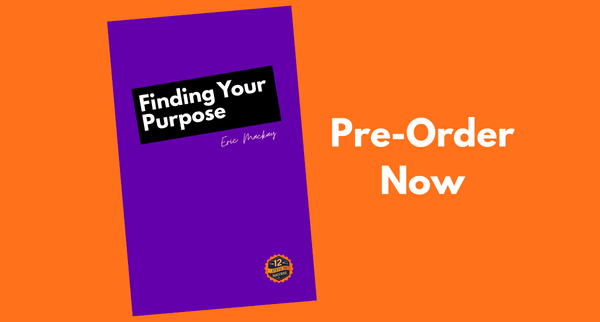
12 Steps to Success: Finding Your Purpose
Now Available for Pre-Order
The point this book comes from wasn’t a moment where everything fell apart in a way that made sense.
It came afterwards.
After I’d already walked away from something stable to try and build something that felt more meaningful. After I’d convinced myself that this time it was aligned, that this time it was coming from the right place. And then watching it collapse anyway.
Not suddenly, not dramatically, just steadily enough that I had time to see it happening and not be able to stop it.
What that leaves you with isn’t just failure. It’s something more uncomfortable than that.
It’s the question of whether the problem wasn’t the thing you were building, but the way you’ve been building your life in the first place.
Because when I really sat with it, properly sat with it, it became very difficult to ignore the fact that I’d spent years shaping a version of myself that worked. That delivered. That made sense to other people. That looked right from the outside.
But I’d never really stopped to ask whether it actually felt right from the inside.
And once you see that clearly, even for a moment, it’s hard to unsee.
Most of the time, that realisation doesn’t arrive through something as obvious as a collapse.
More often, it shows up in quieter ways.
Everything is still working. In a lot of cases, it’s working well. The kind of well that you probably aimed for at some point. The role makes sense. The trajectory makes sense. You can explain how you got there, and it all holds together.
But underneath that, something feels slightly out of place.
Not enough to justify a big decision. Not enough to explain to anyone else without sounding like you’re creating a problem that doesn’t exist. Just enough to notice, if you’re honest about it.
And most people aren’t.
Not because they’re unaware, but because there’s no immediate reason to do anything differently. There’s always something in front of you that needs attention. Something that keeps things moving. And as long as things are moving, it’s easy to assume they’re moving in the right direction.
I did the same thing.
Longer than I should have, if I’m being honest about it.
What I eventually came back to in that period wasn’t something new. It was something I’d already been through, but in a completely different context, when things were far less subtle and a lot harder to ignore.
The 12 steps.
At the time, they weren’t something I analysed or tried to apply broadly. They were simply something that worked when nothing else did. That was enough.
Over time, though, their role changed.
Not because they offer answers, but because they force a level of honesty that most of us are very good at avoiding, especially when things appear to be working. They don’t help you optimise what you already have. They make you look at whether it actually fits.
And that distinction matters more than most people realise.
Because you can build something that works, and still feel completely disconnected from it.
The conversations that became the podcast came from that same place.
Different people, completely different lives, but a familiar pattern in how these moments show up. Points where what they’ve built still holds together externally, but no longer feels right in the way that actually matters.
Those conversations don’t resolve that tension.
If anything, they make it harder to ignore.
This book comes out of that.
What This Is, and What It Isn’t
12 Steps to Success: Finding Your Purpose isn’t an attempt to turn purpose into something neat, or to offer a version of success that feels more acceptable.
It’s what came out of doing the work when things stopped lining up, and not being able to pretend otherwise.
The 12 steps sit at the centre of that, not as an abstract framework, but as something that demands honesty. Not the kind that sounds good when you say it out loud, but the kind that forces you to look at the gap between what you’re doing and what actually feels true.
They don’t give you a better version of yourself to aim at.
They take away the ability to keep performing one that doesn’t fit.
This isn’t about improving what already exists. It’s about recognising when it no longer makes sense, even if it still works, and being willing to sit with that long enough to understand why.
That’s not a clean process. It’s not quick, and it doesn’t move in a straight line. There are parts of it that feel like progress, and parts that feel like you’ve undone more than you’ve built.
But over time, if you stay with it, something shifts.
Not in a way that looks impressive, but in a way that feels more solid. Less dependent on how things appear, and more grounded in whether they actually hold together.
That’s what this book is built around.
Where This Comes From
There’s a natural tendency, especially when things are working, to stay focused on what comes next.
What needs to be built. What needs to be delivered. What needs to keep moving forward.
That focus has value, but it also creates very little space to ask a more uncomfortable question, which is whether any of it still makes sense in the way that matters.
Most people don’t ask that question until something forces them to.
For me, that moment came after everything I thought was aligned collapsed anyway.
This book is what came out of not waiting for that to happen again.
Pre-Order
The Kindle edition is available to pre-order now, with paperback and hardback releasing on launch (31st March 2026).
If there’s anything that sits underneath both the podcast and the book, it’s this.
Things rarely fall apart in a way that makes the decision obvious.
They tend to drift, in ways that are easy to justify at the time and harder to ignore later.
And the point at which you stop justifying it, and actually look at it properly, tends to shape what happens next.