Eric Mackay
The CEO as Content Creator (and Why That Terrifies Me)
Apparently, it’s not enough to run a company anymore, you have to narrate the experience while you’re doing it. Leadership is now a live performance.
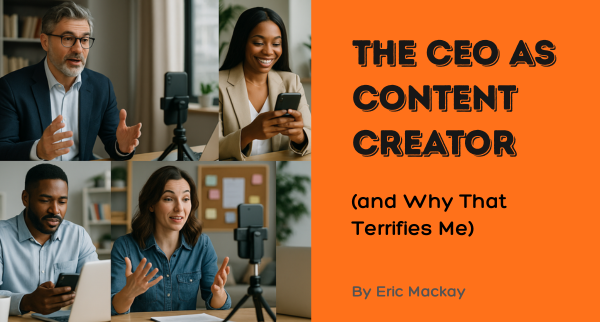
There’s a new item on the modern CEO job description that no one seems to have questioned: content creator. Somewhere along the way, “vision and leadership” became “vision, leadership, and regular social media updates documenting both.” This is most obvious on LinkedIn where everyone has a ‘hot take’ and the amount of rage-bating posts chasing algorithmic boosts is exhausting!
Apparently, it’s not enough to run a company anymore, you have to narrate the experience while you’re doing it. Leadership is now a live performance. We’ll all be headlining MSG before you know it!
And if I’m honest, this thought gives me anxiety. Not the mild kind (if ONLY it was the mild kind) but this is the kind that makes you second-guess whether you’re even built for this version of visibility.
I’ve spent years helping creators – and more recently executives - find ways to tell their stories, yet the idea of doing it for myself feels like a completely different game. It’s not the writing that’s the problem. It’s the exposure. The self-documentation. The feeling that every post needs to walk that impossible line between authentic and algorithmically approved.
When Did This Become a ‘Thing’?!
It’s worth asking how we ended up in a world where every founder is expected to be a micro-media company.
Part of it is cultural. We’ve spent a decade watching people like Musk, Sandberg, and Altman turn their personalities into platforms. Social media rewarded individuals over institutions. People don’t trust logos; they trust faces. So the logic is simple: if your company is invisible, maybe you need to be more visible yourself.
Then came the pandemic, which flattened the hierarchy of communication. Suddenly, everyone - from global CEOs to small business owners - was broadcasting from their spare rooms. Mostly on Zoom calls, though some took it further by experimenting with how they showed up professionally on social media. That shift didn’t go away. What began as a stopgap became the norm.
And of course, the algorithms love it. Platforms like LinkedIn, X, and TikTok don’t care what your title is - they care how human you appear. The more personal you are, the more engagement you get. Authenticity became currency, and we’ve all been minting our own versions ever since.
If this sounds familiar, it should. The music industry got here first. Like we always do; long before any other industry. Artists have been told for years that success isn’t just about the music anymore, it’s about “building a personal brand.” Every song is a product, every post is a campaign, and every offhand thought is content. The modern founder and leader is now living that same equation.
The Anxiety Behind the Lens
For people like me, this expectation doesn’t come naturally.
When I look at some of peers who seem to do it effortlessly - the ones turning every investor meeting into a TED Talk and every product update into a short film - I admire them. But I also feel a creeping sense of inadequacy.
Self-promotion has never felt like my native language. Early on in my founder journey, someone told me ‘be more American when talking about yourself’, basically ‘be less British.’ I can write analysis, strategy, or commentary for days, and put me on a panel at a conference and I can share my knowledge and experience with a theatre full of people. But put a camera on me and turn the focus inward, then everything immediately tightens.
There’s also the question of boundaries. How much of yourself do you share before it starts to feel like performance rather than leadership? I’ve written a lot in my new book about how being performative is one of the quickest ways to not live in line with your purpose, as you’re only ever doing things for someone else. We’ve built platforms that reward exposure but offer little room for nuance. You can be insightful, but only if it’s snackable. Vulnerable, but only if it fits the tone of the feed.
It reminds me of something I wrote about artists a while back: when visibility becomes obligation, it stops feeling like expression.
Why It Matters
The uncomfortable part is that the system isn’t wrong. Visibility does build trust. Founders who communicate openly tend to attract talent, investment, and community faster than those who don’t.
But it’s also created a subtle distortion: we’ve started to equate leadership with content output. If you’re not posting, are you even leading?
In music terms, it’s like being asked to release a single every week just to prove you still exist. The rhythm becomes relentless. You can’t just be the artist anymore; you have to constantly document being the artist.
The same now applies to CEOs and founders. It’s not enough to build. You have to broadcast.
Finding a Way Through
So how do you navigate this if, like me, the thought of performing your working life online makes your stomach tighten?
I’ve been thinking about a few ways to make it less unbearable - and maybe even meaningful. Fair warning: this is my trying to implement these myself. Hopefully to some degree of success but I know that not all of it will be, and that’s ok, as the goal is to just start and then see where it goes.
So here’s what I’m thinking - and I hope these ideas can help you too…
1. Redefine what “content” means.
It doesn’t have to be polished video or neatly branded graphics. It can be simple reflections, lessons from a challenge, or even an observation from your day-to-day work. Some of my favourite posts from others aren’t announcements - they’re small, honest insights about how they’re learning.
2. Build structure around spontaneity.
The best creators aren’t improvising every day - they’re systematising how their thoughts become output. If you’re like me, and structure helps, try blocking time for writing. I know that if I have a block of time in my calendar for writing (or social media scheduling), then it takes away one of the hurdles of trying to find the right time to get inspired – as most of what I write doesn’t need a bolt of lightning, just a blocked hour and a coffee.
3. Start from service, not self-promotion.
The moment I stop thinking about “how this makes me look” and start thinking “would this help someone else?” the anxiety softens. Most people don’t want to see a highlight reel - they want context, honesty, and the occasional useful takeaway.
4. Allow imperfection.
You don’t need a brand voice. You already have a voice. The more you polish it, the less it sounds like you. I also realised that I self-edit way more online than I do in person. I swear. I’m loud and energetic - all things I told myself I couldn’t be online. And that’s simply not true! So get ready for some f-bombs!
Maybe the real goal isn’t to become a “content creator” at all. Maybe it’s simply to become a little more comfortable being visible - to see storytelling not as self-promotion, but as another form of leadership.
A Final Thought
If I’ve learned anything from the creators I’ve worked with, it’s that vulnerability is a skill. It’s uncomfortable at first, but it gets easier when you see what it gives back.
So, yes, the thought of becoming a content-producing founder, author, leader (I don’t even know what to call myself anymore) still terrifies me. But I’m going to try anyway - awkwardly, inconsistently, maybe even badly at first. Definitely badly at first! Because the alternative is silence - and silence isn’t humility. It’s invisibility.