Eric Mackay
The Untapped Power of Scripted TV
A deep dive into music-driven TV shows. Not just the ones that use music as wallpaper, but the ones where music is the story; and what would it take to create more of these shows, and make them globally sustainable?
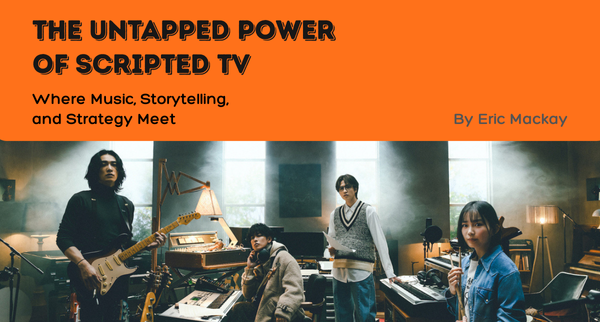
The Untapped Power of Scripted TV:
Where Music, Storytelling, and Strategy Meet
I was talking to a friend the other day, running through some ideas for what to write about next and, honestly, I had some ideas that interested me, but they were definitely more ‘rants’ than thoughtful industry analysis pieces.
And then it happened.
A new obsession came flooding into my life!
As soon as the music started, I was hooked. A sound that hits you like a memory you didn’t quite place - but you feel it. It’s earnest and raw but polished enough to stick with you. Layered vocals carry a kind of unresolved ache, guitars edge between steady and urgent, and the rhythm feels like it’s both holding something back and on the verge of bursting open. It’s the kind of music that makes you slow down and listen again, hoping to catch something you missed the first time. It’s intimate, and it pulls you into their world without warning.
Oh, and did I mention it’s a TV show?!
Welcome to the world of TENBLANK from Netflix’s new J-Drama series, Glass Heart.
I binged the whole series in 2 days and immediately wanted more!
I’m writing this while sitting in the lounge at LAX, listening to the TENBLANK album that accompanies the series, on my way to Nashville. You know, the place from that other TV show!
And to be clear, the Glass Heart album isn’t a soundtrack - it’s a full band record, released through Warner Japan. There’s merch, a fan meet-up in October, and the whole thing is built like a genuine artist campaign. And, as an added bonus, the show itself is fantastic.
So this got me thinking about music-driven TV shows in general.
Not just the ones that use music as wallpaper - but the ones where music is the story. Where the songs carry the emotion, where the characters live inside the industry, and where the line between fiction and real-world culture starts to blur.
Shows like Nashville, Empire, Smash, Glee, Daisy Jones & The Six, and now Netflix’s Glass Heart.
Individually, they feel like cultural moments. But taken together, they point to something bigger: an opportunity hiding in plain sight. These shows don’t just entertain us; they create music products, drive tourism, shift perceptions, and export culture at scale. And yet, they’re expensive and hard to make - which is why so many never get greenlit, or collapse under their own ambition.
The question I’ve been asking is: what would it take to make more of these shows possible - and make them sustainable globally?
The Magic of Music-Driven Stories
There’s something different about scripted shows built around music. When they work, they hit on three levels at once:
1. They Create Music Products, Not Just Episodes
Glee is the clearest example. Over six seasons, it sold 36 million singles and 11 million albums globally. Those weren’t background tracks; they were characters performing the songs we then downloaded, streamed, and sang along to.
Empire did it differently. Every song was original. Timbaland produced a full catalogue for the fictional Lyon family’s record label, and the soundtrack from Season 1 debuted at #1 on the Billboard 200 - the first TV soundtrack to do so in years.
And then there’s Nashville. Across six seasons, the show released over 20 soundtrack albums. Songs from the series were streamed millions of times, performed live on international tours, and embedded in the city’s own identity.
Music wasn’t just part of the storytelling. It was the storytelling - and it generated its own commercial ecosystem.
2. They Build Real-World Fandoms
The best of these shows escape the screen and live in the real world.
- Nashville still spawns multi-city cast tours and reunion concerts years after its finale.
- Glee staged a 40-date arena tour, grossing $40M+ in ticket sales.
- Netflix’s Glass Heart released an entire soundtrack globally on day one, aiming to create a breakout J-pop band in real time.
Fans don’t just watch these shows - they engage. They buy tickets, download soundtracks, post covers on TikTok, and travel across the world to visit sets and landmarks. The shows become cultural events.
3. They Drive Tourism and Local Economies
Tennessee understood this early. When producers pitched Nashville, the state backed it with bespoke incentives. Not because of ratings potential - but because of what the show could mean for tourism.
It worked.
The Bluebird Café, once a local secret, became a global destination with ticket demand so high it moved to lottery systems. Hotels and venues featured in the series saw spikes in bookings. The show created hundreds of local jobs and delivered years of free advertising for “Music City.”
Scripted entertainment became a long-term economic engine. That’s the kind of multiplier effect policymakers rarely predict - but Nashville proved it.
Why These Shows Are So Hard to Make
For all their upside, music-driven scripted series are expensive and complex to produce.
A few reasons why:
- Music rights and licensing: Covering a well-known track can cost anywhere from $10K to $100K per episode.
- Original compositions: Producing full albums requires songwriters, producers, studio time, and distribution.
- Performance staging: Live shows, choreography, and on-screen concerts drive costs up further.
- Casting challenges: Triple-threat talent (acting, singing, dancing) narrows the talent pool and increases rehearsal time.
- Creative pace: Writing scripts and songs in parallel makes timelines brutally tight.
Ambition simply isn’t enough - you need everything to work in sync, while also having extensive structural support to make these shows financially viable.
Showrunner Turnover and Creative Burnout
One of the most underestimated challenges in producing music-driven scripted series is finding leadership that can balance two competing disciplines: TV storytelling and musical structure. Few showrunners are fluent in both - and the strain shows.
Take Smash (NBC, 2012–2013), a Broadway-set drama about the creation of a fictional Marilyn Monroe musical. Despite big names behind it - Steven Spielberg was an executive producer - its original showrunner, Theresa Rebeck, clashed with network executives over creative direction and struggled to manage the sheer scale of production. After one season, she stepped away amid mounting criticism, leaving the show without a consistent vision.
Nashville (ABC/CMT, 2012–2018) faced similar turbulence later in its run. Creator Callie Khouri, who won an Oscar for Thelma & Louise, left before the final season after reported tensions with the network over tone and direction.
The pressure is relentless. These shows don’t just need drama; they need hit songs every week, too. Writers’ rooms often fracture over core questions: Should the tone lean “soapier” or more grounded? Do we prioritise the songs, or the plot? Rights clearances can throw further chaos into the mix - if a key track isn’t cleared in time, entire scenes may have to be rewritten or reshot at the last minute.
It’s why burnout among creative leads is common. Musical dramas demand multitaskers with a clear vision who can keep story, music, and production moving in sync - but even with the right person at the helm, the odds are stacked against them.
The Creative Workload Problem
The workload on music-driven series is uniquely intense, stretching every department involved.
On a typical drama, scripts are finalised close to shoot dates. For a musical drama, though, writers have to lock storylines and integrate songs seamlessly into character arcs - which means the songwriting process often starts months earlier and continues deep into production.
Take Crazy Ex-Girlfriend (The CW, 2015–2019), a cult-favourite musical dramedy known for three to four original songs per episode. Creators Rachel Bloom and Aline Brosh McKenna worked alongside a dedicated songwriting team to write, compose, and record these tracks under relentless deadlines. Bloom has openly described working “almost continuously” just to keep up with the pace.
The cast, too, carries extra weight. Beyond learning dialogue, they’re recording vocals, rehearsing choreography, and shooting performance-heavy scenes - all while following the same production schedule as a non-musical drama.
It’s a gruelling pace that few productions sustain without friction. When these shows succeed, it’s usually because the writers’ room, music department, and production unit operate like one integrated organism. But reaching that harmony takes a rare alignment of creative vision, technical skill, and stamina.
The Tension Between Ambition and Sustainability
And yet - for all the challenges - when a scripted music series hits, it doesn’t just work; it transcends. These shows can shape culture, move markets, and build global fandoms in ways most genres can’t match.
That’s what makes the stakes so high. Without structural support, many productions collapse under the weight of their own ambition. Budgets balloon, timelines snap, and creative teams burn out. Vinyl burned through ~$30M on its pilot before HBO pulled the plug. Netflix’s The Get Down ballooned to ~$120M for one season before being cancelled.
The problem isn’t creativity - there’s no shortage of ideas, talent, or audience demand. The problem is economics. A show like Glass Heart demonstrates the potential scale, but making these projects viable long-term requires reducing the risk for creators, studios, and distributors alike.
Why Incentives Are the Strategic Enabler
This is where policy meets strategy.
Tax incentives, rebates, and production credits aren’t just helpful add-ons - they’re the quiet enablers behind some of the most successful music-driven hits.
Nashville happened because Tennessee created bespoke incentives to offset production costs.
Georgia has become one of the U.S.’s busiest production hubs, offering up to 30% transferable credits - a model that’s lured high-profile (non-music) series like Stranger Things.
Canada’s blended federal and provincial credits often exceed 35%, supporting performance-heavy productions.
The UK offers 25% rebates paired with studio infrastructure optimised for live recording.
And then there’s Japan…
As I covered in a previous post, despite having one of the most dynamic music ecosystems in the world, there’s no centralised national framework for supporting scripted music series (or music export in general). Some prefectures offer modest grants, but they’re inconsistent and small-scale. It’s why Glass Heart, despite its breakout potential, had to lean heavily on Netflix’s global infrastructure rather than coordinated local policy support.
If Japan unified its approach, it could position itself as a global hub for scripted musical dramas - exporting not just shows, but also soundtracks, cultural influence, and soft power at scale.
Streaming Platforms Are Ready for This
Netflix, Amazon, Disney+, and Apple are hungry for multi-product IP - shows that come bundled with soundtracks, live experiences, and fandoms.
- Netflix: Betting big on Glass Heart and doubling down on K-drama OSTs.
- Amazon Prime: Daisy Jones & The Six paired its storytelling with an Atlantic Records album launch.
- Disney+: Turned High School Musical: The Musical: The Series into a franchise of spin-offs, live shows, and endless merch.
Streamers want formats that do more than deliver episodes. They want cultural events. And music-driven scripted dramas have a unique advantage: they generate discoverable assets - playlists, TikTok trends, global fan campaigns - that keep IP alive long after the finale and which single-handedly maintain buzz between seasons.
Where the Opportunity Sits
The next wave of scripted music-driven dramas will come from markets where three forces converge: a thriving local music ecosystem, incentive frameworks that lower production risk, and streaming platforms actively seeking formats that can travel globally. When those forces align, the upside isn’t just creative, it’s economic.
And what’s interesting is how unevenly the pieces are falling into place.
South Korea offers a glimpse of what happens when culture and strategy move in sync. K-pop dominates global playlists, K-dramas consistently top Netflix charts, and government-backed incentives underpin the industry’s growth. A scripted K-pop series, tied to OST releases and existing fan ecosystems, wouldn’t just succeed - it would scale instantly.
India is approaching a similar inflection point. With OTT platforms projected to reach over 500 million users by 2027, a Bollywood-style scripted series blending narrative and original music could serve both a vast domestic audience and the global diaspora - creating natural export pathways.
In Nigeria and Ghana, Afrobeats has already transformed the global soundscape, yet scripted storytelling hasn’t caught up. A Lagos- or Accra-based drama could showcase local talent, celebrate music scenes driving streaming trends worldwide, and capitalise on Netflix and Amazon’s aggressive expansion into Africa.
And Latin America already has proof of concept. The original Mexican series Rebelde became a cultural phenomenon, launching RBD - a real-life band that sold over 15 million albums worldwide. The 2022 Netflix reboot shows the appetite is still there, and Spanish- and Portuguese-language originals are perfectly placed to scale regionally and re-export globally.
I’ve already covered how Japan could benefit from centralised frameworks to support the export of its musical IP - and that’s before even considering how theatrical genres like Visual Kei are primed for multi-media expansion. With stronger policy alignment, Japan could position itself as a global hub for music-driven storytelling.
Finally, there are established hubs like the UK, Canada, and the U.S. - particularly Tennessee and Georgia - where deep music heritage meets generous tax incentives and world-class production infrastructure. These regions are natural launchpads for global co-productions, especially where live performance is central to the storytelling.
The sweet spot sits where music ecosystems, policy frameworks, and platform ambitions intersect. Right now, that alignment is patchy - but as streamers chase global audiences and local markets compete for investment, the regions that move fastest will define the next generation of scripted music hits.
Unlocking the Potential
Right now the opportunities exist, but the frameworks to support them don’t. Productions like Glass Heart rely heavily on platform financing, and that limits how fast the model can scale.
For these shows to thrive globally, three pieces must connect:
- Governments creating smarter incentive programmes.
- Streamers co-investing with local markets.
- Music industries actively shaping formats designed for export.
Do that, and scripted music dramas stop being one-off successes. They become a repeatable strategy - one where countries with rich music cultures turn creativity into economic growth and global influence.
The recent announcement of the partnership between CN ENM in Korea and Japan's Hakuhodo to develop IP for global audiences could even be the first step towards this becoming a reality, although, it looks like they're focusing on unscripted reality shows to start with, which don't necessarily have the same kind of mass cultural impact.
Final Thought
Scripted musical dramas aren’t just content; they’re cultural assets. They can shape global playlists, drive tourism, and position entire music industries on the world stage. But to scale, we need systems - frameworks where governments, platforms, and local creators share both the risk and the reward.
The streaming platforms are ready. The music industry is ready. The audiences are hungry.
Now it’s about building the partnerships and policies to make these shows not just possible - but globally inevitable.